


Raccoon Removal in Citrus County, Florida
- Aug 10, 2020
- 8 min read
Updated: Aug 2
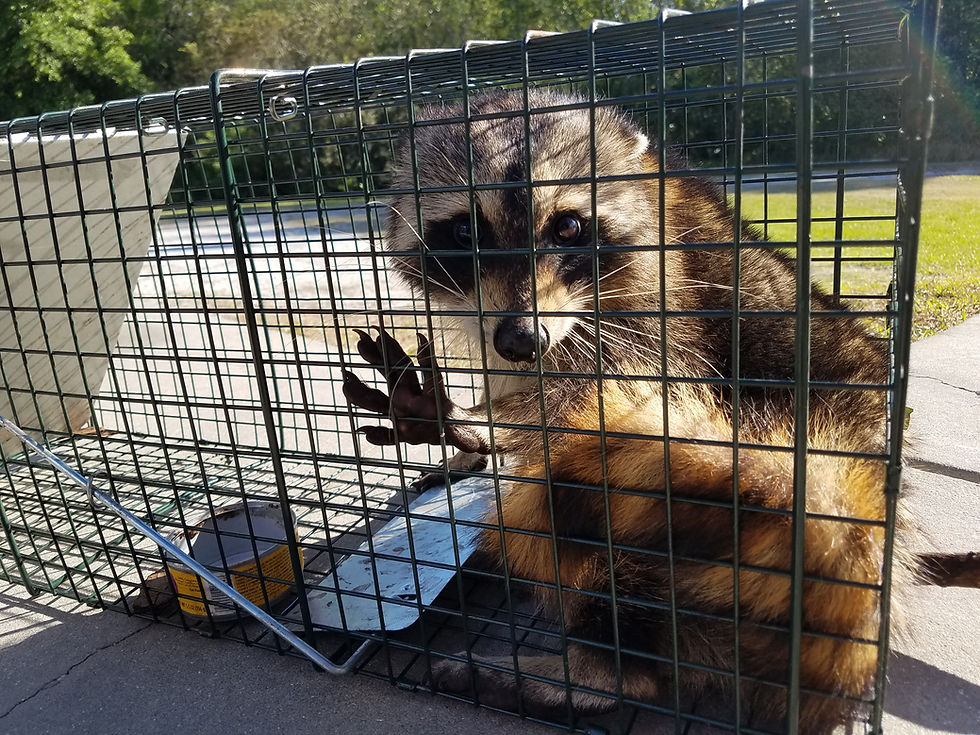
Raccoons are intelligent, adaptable, and surprisingly good at turning small construction weaknesses into very expensive home repairs.
Seeing one wandering through your yard at night is not automatically a problem. Raccoons are common throughout Florida and are highly successful at living alongside people. But when one moves into your attic, crawl space, soffit, chimney, or another part of your home, the situation changes quickly.
Nature-Tech Wildlife Solutions provides professional raccoon removal, attic inspections, wildlife exclusion, and structural entry-point repairs throughout Crystal River, Homosassa, Inverness, Lecanto, Beverly Hills, Hernando, Floral City, Citrus Springs, and surrounding Citrus County and Nature Coast communities.
Our approach is simple:
Remove the immediate problem, identify why it happened, and help prevent the next raccoon from moving in.
Does Seeing a Raccoon Mean I Have a Problem?
Not necessarily.
FWC specifically distinguishes between wildlife simply being present and wildlife actually becoming a nuisance. An animal generally becomes a nuisance when it causes or is about to cause property damage, threatens public safety, or creates an annoyance in, under, or around a building.
So a raccoon walking through your backyard at night?
Probably just a raccoon being a raccoon.
A raccoon tearing open your soffit and raising young over the master bedroom?
Now we have a wildlife conflict.
That distinction matters to us at Nature-Tech.
We do not believe every wild animal on a property needs to be removed. We focus on the individual animal actually causing the problem.
Why Do Raccoons Enter Homes?
Raccoons are opportunistic.
In natural environments, they commonly use tree cavities and other sheltered spaces. In developed areas, attics, crawl spaces, decks, sheds, culverts, and similar structures can provide the same kind of protected shelter. UF/IFAS specifically notes that raccoons readily use attics and crawl spaces when natural den sites are limited or less convenient.
Homes offer:
Shelter from weather
Protection from predators
Warm nesting space
Secluded areas for raising young
Easy access to nearby food and water
From the raccoon’s point of view, your attic can look like a luxury tree hollow with insulation.
Unfortunately, the mortgage company usually disagrees.
Common Raccoon Entry Points
Raccoons are strong enough to exploit weak areas and sometimes enlarge existing damage.
Common entry areas include:
Damaged soffits
Roof returns
Fascia gaps
Loose soffit panels
Roof-to-wall intersections
Chimneys
Crawl-space openings
Damaged vents
Areas previously opened by other wildlife
Your existing page already shows a classic soffit/roof-return breach, which is exactly the kind of real field photo I would keep.
This is also where your construction background becomes a real advantage.
Finding the raccoon is only half the inspection.
The other half is understanding how the building failed.
Why Is There a Raccoon in My Attic?
What About Baby Raccoons?
Baby raccoons are called kits, and this is one of the most important considerations in attic raccoon removal.
When a female has established a den inside a soffit or attic, her young may be hidden in areas that are difficult to see from the main attic space.
As the kits grow, they begin moving around.
And sometimes they get themselves spectacularly stuck
Should I Just Seal the Hole?
No.
Not until you know what is inside.
Closing an active raccoon opening before the animals have been removed can create a much bigger problem.
A trapped adult may:
Tear through additional construction
Enter interior living areas
Damage ductwork
Destroy insulation
Create a new escape opening
And if the mother is locked outside while kits remain inside, the situation becomes even worse.
The sequence matters:
Inspect → Identify → Remove/Resolve → Verify → Repair.
Not:
See hole → seal hole → discover furious raccoon.
What Damage Can Raccoons Cause?
Raccoons are capable of creating significant damage during long-term occupancy.
Common problems include:
Torn or compressed insulation
Damaged flexible ductwork
Soiled attic areas
Damaged soffits and fascia
Enlarged roof openings
Urine and fecal contamination
Nesting material
Damaged vapor barriers
Damage around crawl spaces or decks
Your existing page is right to emphasize that long-term attic occupancy can become expensive.
This is why catching the animal is often the cheapest part of the job.
The structural and sanitation consequences can be much larger.
Raccoon Droppings and Latrines
This deserves its own section.
Raccoons often repeatedly defecate in the same location, creating what is known as a latrine.
FWC warns that raccoon feces can contain raccoon roundworm and specifically advises avoiding direct contact and using proper precautions around suspected latrine areas.
If raccoon feces have accumulated in an attic, crawl space, or yard, avoid unnecessary contact and use appropriate protective measures. Significant contamination may require professional cleanup or remediation.
Do Raccoons Carry Rabies?
Yes, raccoons can carry rabies.
That does not mean every raccoon represents a rabies emergency.
But any wild raccoon that bites or scratches a person or pet should be taken seriously, and appropriate medical or veterinary guidance should be sought.
FWC also warns that sick raccoons can show neurologic signs from conditions such as canine distemper, which can look similar to rabies. They advise treating sick raccoons cautiously and avoiding direct contact.
Signs That Warrant Extra Caution
Avoid approaching a raccoon that is:
Staggering
Extremely disoriented
Unable to stand normally
Acting unusually aggressive
Showing severe neurologic symptoms
Appearing obviously sick or injured
And keep pets and children away.
Are Daytime Raccoons Sick?
Not automatically.
This is another myth worth correcting.
Raccoons are often described as nocturnal, but daytime activity alone does not prove illness.
A mother caring for kits may forage during daylight hours. Food availability, disturbance, seasonal conditions, or learned behavior can also influence activity patterns.
So:
Daytime raccoon ≠ automatic rabies diagnosis.
Behavior and overall condition matter much more than the clock.
What Attracts Raccoons to a Property?
FWC identifies several common attractants, including garbage, pet food, fruit, bird feeders, livestock feed, crawl spaces, and chimneys.
Common residential attractants include:
Unsecured garbage
Pet food left outside
Birdseed
Fallen fruit
Compost
Chicken feed
Backyard poultry
Outdoor freezers
Easy access beneath decks or homes
Open chimneys
Existing roof or soffit damage
Removing these attractants can dramatically reduce repeated activity.
And please do not intentionally feed raccoons.
FWC specifically warns that feeding wildlife can reduce their natural fear of people and increase conflict.
Raccoons and Backyard Chickens
Raccoons are extremely capable poultry predators.
They can climb, manipulate latches, reach through openings, and exploit weak construction.
A coop that keeps chickens inside does not necessarily keep raccoons outside.
For more information on chickens and predation, please read our article: Poultry and Predators.
If you're losing chickens or finding signs of predator activity around your coop, identifying the actual predator is important before deciding on a solution. Raccoons, foxes, bobcats, coyotes, opossums, snakes, raptors, and domestic dogs can all create poultry conflicts.
Why Trapping Alone Often Isn't Enough
Suppose we catch the raccoon.
Great.
Now what happens to the hole?
If the entry point stays open, another raccoon, squirrel, rat, opossum, or other animal may eventually use it.
That's why removal and exclusion should usually be treated as two pieces of the same problem.
Removal addresses the animal.
Exclusion addresses the building.
Raccoon Exclusion and Repairs
Once we are confident the animals are out, exclusion may involve:
Soffit reconstruction
Fascia repair
Roof-return repair
Vent reinforcement
Chimney caps
Crawl-space repair
Screening vulnerable openings
Repairing previous wildlife damage
And this is where I would absolutely repeat your homepage message:
Wildlife exclusion should work without making your home look patched together.
Whenever practical, Nature-Tech aims to provide repairs that are durable, functional, and visually appropriate for the structure.
Because “spray foam and chicken wire everywhere” should not be the default architectural style.
Our Raccoon Removal Process
1. Inspect the Property
We identify signs of raccoon activity, entry points, structural damage, contamination, and potential denning areas.
2. Determine Whether Young Are Present
If a female is denning inside the structure, dependent kits may change how the removal should be handled.
3. Resolve the Wildlife Conflict
The appropriate method depends on the animal, structure, and circumstances.
Florida nuisance wildlife rules allow property owners or authorized individuals to address qualifying nuisance wildlife, subject to applicable regulations. Traps generally must be checked within required intervals, and captured nuisance wildlife must be legally handled within the required timeframe.
4. Verify the Structure Is Clear
Before permanently sealing an active entry point, we want to be confident that no raccoons or dependent young remain inside.
5. Repair the Entry Point
Once the wildlife issue is resolved, vulnerable areas can be professionally secured.
6. Recommend Prevention
We identify food sources, structural vulnerabilities, and habitat conditions that could attract future wildlife.
What I See Most Often
Raccoons are a perfect example of why wildlife removal cannot be separated from construction.
A homeowner usually sees the raccoon.
I usually see the raccoon and the building failure behind it.
The animal may be the reason the customer called, but the opening in the soffit, damaged roof return, failed vent, or loose fascia is often the reason the problem exists.
If we remove the raccoon and ignore that opening, we haven't really solved the problem.
We've just created a vacancy.
And Florida has plenty of applicants.
Frequently Asked Questions About Raccoon Removal
Will a raccoon leave my attic on its own?
It may leave temporarily to forage, but if the attic has become an established den or nesting site, the raccoon may continue returning.
If kits are present, the mother has an even stronger reason to come back.
How can I tell if a raccoon has babies?
You may hear high-pitched vocalizations, movement from multiple animals, or activity concentrated around a nesting area. A professional inspection can help determine whether dependent young are present.
Can I remove a raccoon myself?
Florida property owners may address qualifying nuisance wildlife on their own property, but they are responsible for complying with applicable wildlife laws and trapping requirements.
The larger issue with attic raccoons is often not the trap itself.
It's identifying the entry point, checking for young, handling the captured animal legally, and repairing the structure afterward.
Should I relocate a raccoon?
Not casually.
FWC recommends trapping and relocation as a last resort after proactive conflict-prevention measures have failed.
Also, relocation rules and disease concerns make this more complicated than simply driving an animal to the nearest wooded area.
Is raccoon poop dangerous?
Raccoon feces can contain parasites, including raccoon roundworm. Avoid unnecessary contact with latrine areas and use appropriate cleanup precautions.
Why does the same raccoon keep coming back?
Usually because something worthwhile remains there.
That may be:
An established den
Accessible garbage
Pet food
Chickens
Birdseed
A convenient structural opening
A dependable shelter site
Remove the attraction or repair the access and you have a much better chance of solving the problem long term.
Should raccoons in my yard be removed?
Usually not simply because they are present.
FWC specifically recommends distinguishing between normal wildlife presence and an individual animal actually creating a nuisance conflict.
Need Raccoon Removal in Citrus County?
If you're hearing heavy movement in the attic, seeing raccoons entering the roofline, finding damage around soffits, or dealing with raccoons beneath your home or around backyard poultry, Nature-Tech Wildlife Solutions can help.
We provide professional raccoon removal, attic inspections, wildlife exclusion, structural repairs, and prevention services throughout Crystal River, Homosassa, Inverness, Lecanto, Beverly Hills, Hernando, Floral City, Citrus Springs, and surrounding communities throughout Citrus County and Florida's Nature Coast.
We'll identify what the raccoon is doing, determine how it gained access, check for dependent young when appropriate, and help repair the conditions that allowed the problem to develop.
Protecting Homes. Respecting Wildlife. Building Lasting Solutions.
Call today for your FREE inspection: 352.783.5594


Comments